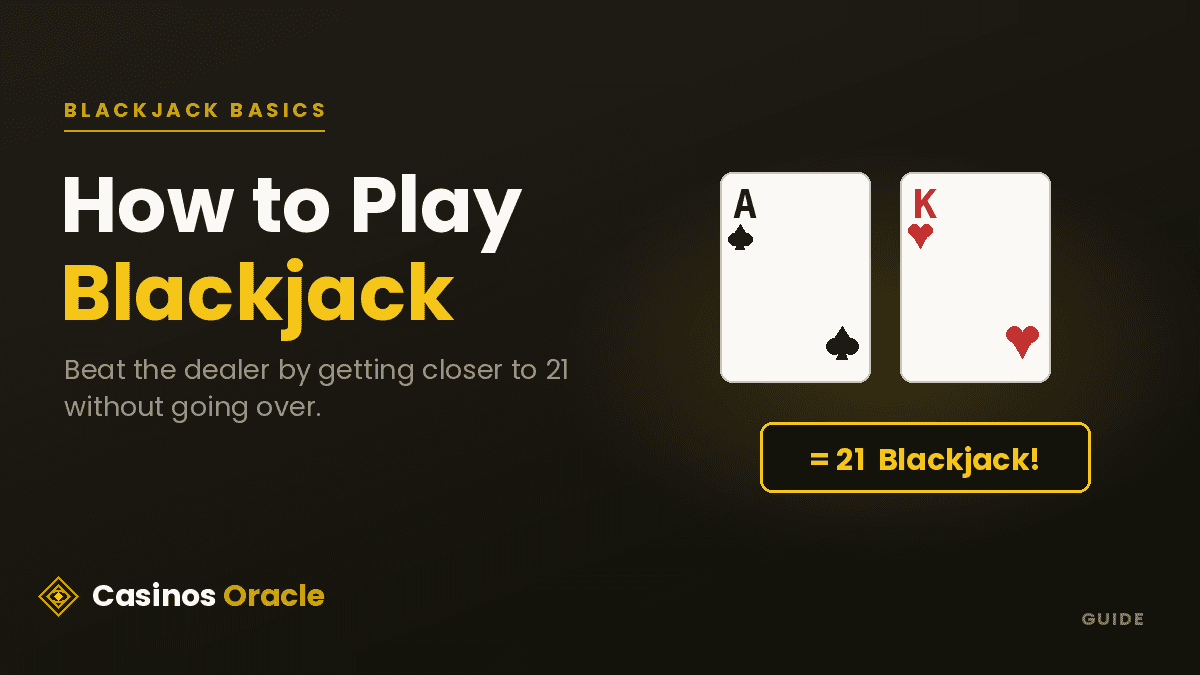
The goal in blackjack is straightforward: finish the hand with a higher total than the dealer without going over 21. You’re not playing against other players — just the dealer. And unlike slots or roulette, your decisions actually affect the outcome. That’s what makes blackjack interesting, and why learning to play correctly is worth the effort.
Card Values
Number cards (2–10) are worth their face value. Face cards — Jack, Queen, King — are all worth 10. Aces are worth either 1 or 11, whichever helps your hand more.
A “soft” hand contains an Ace counted as 11 without busting (e.g., Ace + 6 = soft 17). A “hard” hand has no Ace, or has one that must count as 1 to avoid a bust (e.g., Ace + 9 + 6 = hard 16, because counting the Ace as 11 would give 26). This distinction matters for strategy — the game treats hard and soft hands differently.
A “blackjack” (or “natural”) is an Ace plus any 10-value card on the initial deal. It typically pays 3:2 — a $10 bet wins $15. More on payouts below.
How a Round Works
You place your bet before any cards are dealt. The dealer then gives everyone two cards, usually face-up for the player and one face-up plus one face-down for the dealer (the face-down card is the “hole card”). You see your two cards and one of the dealer’s.
You act first. Once all players at the table have completed their hands, the dealer reveals the hole card and plays their hand according to fixed rules — no decision-making on the dealer’s part. The dealer must hit until reaching 17 or higher, then must stand. Variants differ slightly (see below).
If your hand exceeds 21, you bust and lose immediately — the dealer doesn’t need to play out their hand to take your bet. If the dealer busts, all players still in the hand win.
Player Actions
Hit
Take another card. You can hit as many times as you like until you stand or bust. In online blackjack, clicking “Hit” draws one card at a time.
Stand
Keep your current hand and take no more cards. The dealer then plays.
Double Down
Double your original bet in exchange for receiving exactly one more card. Available on the initial two-card hand, sometimes restricted to totals of 9, 10, and 11 depending on the variant. Used correctly, doubling down is the most profitable move in blackjack — basic strategy tells you exactly when to do it.
Split
When your first two cards are a pair (same value), you can split them into two separate hands by placing a second bet equal to your original. Each hand then gets a second card and plays independently. You can generally re-split pairs (up to three or four hands), with one important exception: split Aces usually receive only one card each and cannot be re-split.
Surrender
Give up your hand and recover half your bet. Available at the start of your turn (“late surrender”) before the dealer checks for blackjack. Not all variants offer it — late surrender is valuable and worth seeking out, because folding a bad hand against a dealer’s strong upcard is mathematically correct in specific situations.
Insurance
When the dealer shows an Ace, you’re offered insurance — a side bet paying 2:1 if the dealer has blackjack. The cost is half your original bet. Insurance has a house edge of approximately 5.88% in a typical six-deck game. It’s a bad bet for most players and should almost always be declined. The one exception: card counters who track deck composition and know when the remaining cards favor a dealer blackjack.
Dealer Rules
The dealer follows fixed, predetermined rules — no discretion. The most common: hit on soft 16 or below, stand on hard 17 and above. Some variants use “soft 17” rules where the dealer hits on soft 17 (Ace + 6), which increases the house edge by about 0.2%. When choosing a table, look for “dealer stands on soft 17” (S17) rather than “dealer hits soft 17” (H17).
Payouts
Regular wins pay 1:1 (even money). Blackjack pays 3:2 at good tables — a $10 bet returns $25 total ($15 profit). Watch out for 6:5 blackjack payouts, increasingly common at lower-limit tables: this single rule change adds about 1.39% to the house edge, turning a 0.5% game into a nearly 2% game. 6:5 blackjack isn’t worth playing if a 3:2 table is available.
Basic Strategy: Why It Matters
Basic strategy is a complete chart of optimal decisions for every possible player hand against every possible dealer upcard. It was calculated mathematically in the 1950s and hasn’t changed because the math doesn’t change.
Using basic strategy consistently cuts the house edge to approximately 0.5% in a standard six-deck game. Most players play by feel and intuition, running the house edge closer to 2–4%. The difference between those numbers represents real money over a session.
Basic strategy charts are freely available and legal to use — casinos don’t object to them because most players still don’t bother. You can use one on your phone while playing online. See our Basic Strategy Charts guide for the full decision tables.
Common Beginner Mistakes
- Standing on soft 17 or 18. Soft hands have a safety net — an Ace can drop to 1. Soft 17 should almost always be hit or doubled; standing gives up value.
- Taking insurance. As covered above: bad bet, high house edge, skip it.
- Not splitting Aces and 8s. Always split Aces (starting two separate 11s is a massive advantage). Always split 8s (you’re splitting a weak 16 into two potentially strong hands).
- Splitting 10s or 5s. Never split 10s — you have 20, one of the strongest hands. Never split 5s — you have 10, a prime doubling hand, not a pair to split.
- Playing at 6:5 tables when 3:2 is available. Check the table’s blackjack payout before sitting down. It’s printed on the felt.