The global online gambling market is forecast to surpass $142 billion in annual revenue by 2028, according to Future Market Insights, as a wave of US state-by-state legalisation and accelerating mobile adoption in emerging economies sustain industry growth above 10% per year. Grand View Research projects the figure will reach $153.57 billion by 2030, based on an 11.9% compound annual growth rate (CAGR) from 2025.
Estimates of the market’s current size vary by methodology and scope. Grand View Research puts 2025 global online gambling revenue at approximately $88 billion, while Future Market Insights and Market Research Future use broader definitions that produce figures closer to $105–$116 billion. The divergence reflects different treatments of sports betting versus casino-only revenue, and varying definitions of what counts as a “regulated” market. Across all methodologies, the directional consensus is consistent: sustained double-digit annual growth through at least 2028.
Sports betting accounts for the largest single segment of online gambling revenue globally, representing roughly half of total market value in 2025, according to Grand View Research. Online casino gaming — slots, live dealer tables, and RNG table games — makes up the remainder, with live dealer growing fastest within that category as operators such as Evolution continue expanding their studio footprints.
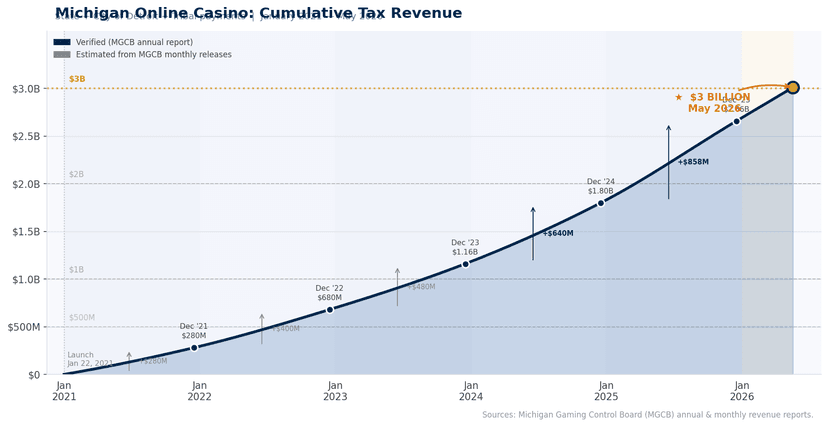
The primary near-term growth engine is the United States. Flutter Entertainment’s FanDuel, DraftKings, and BetMGM are competing aggressively in the eight states where real-money online casino gaming is currently licensed, with record revenue figures reported across multiple markets in early 2026. Several additional states are advancing online casino bills through their legislatures, and each new state that legalises could add $1–$3 billion to the regulated US total annually.
Beyond the US, Brazil’s newly regulated iGaming market — live since January 2025 — is expected to contribute meaningfully to global growth over the forecast period. Ontario’s mature regulated market in Canada continues to expand as new operators receive licences. Parts of Southeast Asia and Latin America are moving toward regulatory frameworks that would open further addressable markets for licensed operators.
For players, sustained market growth typically signals continued competition between operators for market share, which tends to drive investment in game libraries, bonus structures, and platform quality — particularly in newly regulated markets where players are less locked into existing operator relationships.