Bankroll management is the set of rules that determines how much you bet relative to what you have. It doesn’t change the house edge. It doesn’t make losing sessions into winning ones. What it does is control how quickly you lose during bad runs and ensure that a run of bad luck doesn’t wipe out your entire gambling budget in one session. That’s the whole point.
What a Bankroll Is
Your bankroll is the money you’ve set aside specifically for gambling — separate from rent, food, savings, and everything else. It’s money you’re prepared to lose in full without it affecting your life. Treating it as separate from everyday finances is the first step; without that separation, “bankroll management” is just words.
If you don’t have a defined gambling budget, set one before you play. Pick an amount that represents genuine entertainment spending — what you’d pay for other leisure activities over the same period. That’s your bankroll.
Bet Sizing: The 1–2% Rule
The standard guideline for recreational casino gambling: bet 1–2% of your total bankroll per hand or spin. On a $500 bankroll, that’s $5–10 per bet. This gives you 50–100 bets before the bankroll is gone — enough hands to absorb normal variance without going broke in one unlucky streak.
At 2% per bet on a game with a 1% house edge, you’d expect to lose about 2 cents per dollar wagered on average. Over 100 hands at $10 each ($1,000 in total bets), that’s an expected loss of $10. Your $500 bankroll should last far longer than 100 hands in normal play because variance means wins and losses don’t arrive in neat order.
Betting 5–10% of your bankroll per hand is common among recreational players and dramatically increases the chance of a short-session wipeout. At 10% per bet, a run of 10 consecutive losses — not statistically unlikely — would zero your account. At 1–2%, that same run barely dents it.
Session Loss Limits
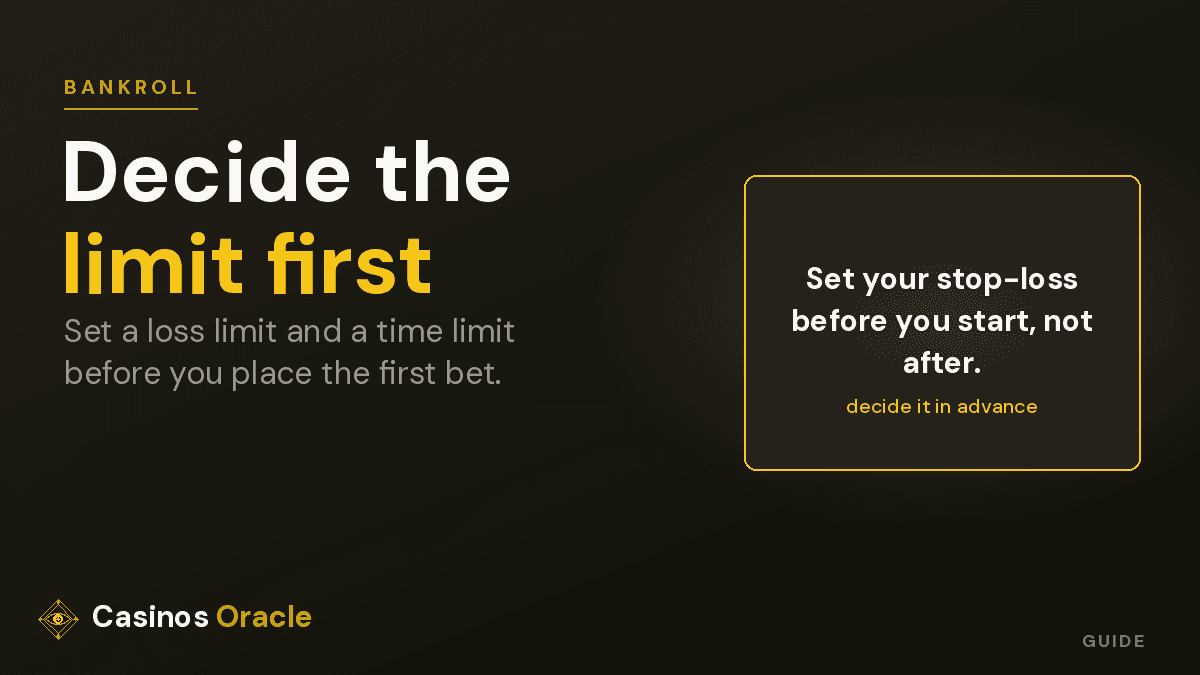
A session loss limit is a predetermined amount you’ll stop playing if you lose it. You set this before you start — not in the moment when you’re chasing losses.
Standard guidance: limit your session loss to 20–30% of your total bankroll. On a $500 bankroll, that’s $100–$150 per session. When you hit that number, you stop. You don’t reload, you don’t decide the situation is different from what you planned — you stop.
The loss limit also serves a second function: it protects your bankroll across multiple sessions. If your total budget is $500 and you protect 70–80% of it from any single session, you preserve the ability to play another day.
Win Goals
Win goals are less mathematically important than loss limits but help session structure. A common approach: set a win goal of 50% of your session budget, and when you hit it, pocket at least half the winnings and continue only with what you started. This prevents the “turned $200 into $350 and left with $80” outcome that many players experience.
Win goals don’t change your expected value — the house edge applies equally to won and unspent money. But they impose discipline on sessions that can otherwise run until all profits are returned.
Choosing Games to Match Your Bankroll
Game volatility matters for bankroll sizing. High-volatility games (slots, especially those with big jackpots and low hit frequency) require larger bankrolls to absorb variance relative to stake size. Low-volatility games (baccarat Banker bet, basic strategy blackjack) run with much less swing per unit wagered.
For a $200 session budget with $5 bets, blackjack with basic strategy will typically sustain play far longer than a high-variance video slot at the same stake. Both games can go either way, but the blackjack variance is smaller, meaning you’re less likely to lose the entire $200 in 20 minutes.
Never Chase Losses
Chasing losses means increasing your bets or reloading your session budget after losing in order to win back what’s gone. It’s the single most destructive behavior in gambling, and it’s driven by the mathematically false idea that you’re “due” for a win.
Past losses are irrelevant to future outcomes. The house edge on the next hand or spin is exactly the same as it was before your losing streak. Increasing bets to recover losses doesn’t improve your odds — it increases your exposure at the worst possible time, when your mental state is most likely to cause poor decisions.
Set the loss limit. Honor it. That’s the full rule.