Every casino game is built so that over a large enough number of bets, the house takes a predictable cut. That cut is the house edge — and understanding it is the single most useful piece of knowledge you can carry into any casino, online or off.
What the House Edge Actually Is
The house edge is the casino’s average profit expressed as a percentage of each bet. On a game with a 5% house edge, the casino expects to keep $5 from every $100 wagered — not on every individual bet, but across millions of bets combined. The variance round-to-round can swing wildly, but the long-run result converges on that number with mathematical certainty.
It exists because payouts on winning bets are always slightly less than the true probability of winning. European roulette: 37 numbers (0–36), 1/37 chance of hitting your number, but the casino pays 35:1 instead of 36:1. That one-unit gap across 37 theoretical bets equals a 2.70% house edge. Nothing complicated — just a gap between true odds and paid odds, built into every wager.
House Edge by Game — the Numbers That Actually Matter
Not all games hit your bankroll equally. The range is wider than most players realize:
| Game / Bet | House Edge | Key Condition |
|---|---|---|
| Blackjack — basic strategy | 0.40–0.60% | Only with correct basic strategy; intuitive play runs 2–4% |
| Video Poker — full-pay Jacks or Better | 0.46% | Perfect strategy required; most machines pay slightly less than full-pay |
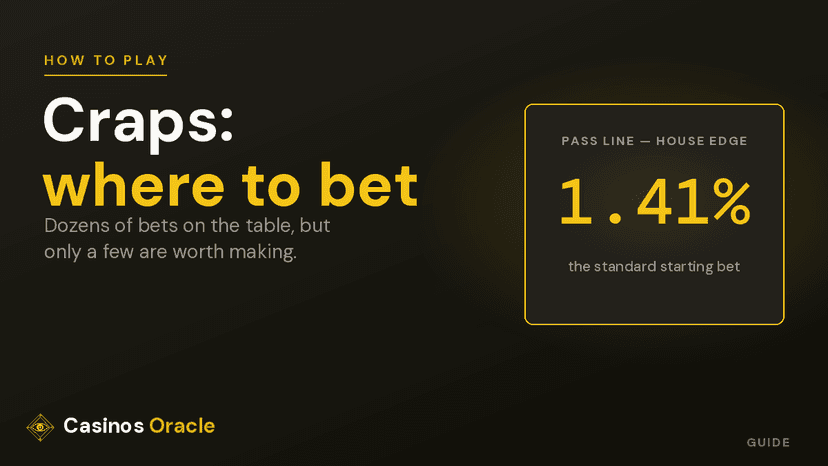
| Craps — Pass/Don’t Pass line | 1.41% / 1.36% | Take maximum odds behind the line and the combined edge drops to under 0.4% |
| Baccarat — Banker bet | 1.06% | 5% commission included; still the best bet at the baccarat table |
| Baccarat — Tie bet | 14.36% | Avoid entirely regardless of the 8:1 or 9:1 payout |
| European Roulette | 2.70% | Single zero; always prefer this over American |
| American Roulette | 5.26% | Double zero nearly doubles the edge vs European |
| Slots | 2–15% | Huge range; check the published RTP for each game |
| Keno | 20–40% | One of the worst bets in any casino, online or offline |
The practical gap here is significant. Playing blackjack with basic strategy versus American roulette is the difference between a 0.5% and a 5.26% house edge. Across $1,000 in wagers, that’s $5 vs $52.60 in expected losses. Over a full evening, that difference is real money leaving your pocket.
RTP: The Same Math, Different Framing
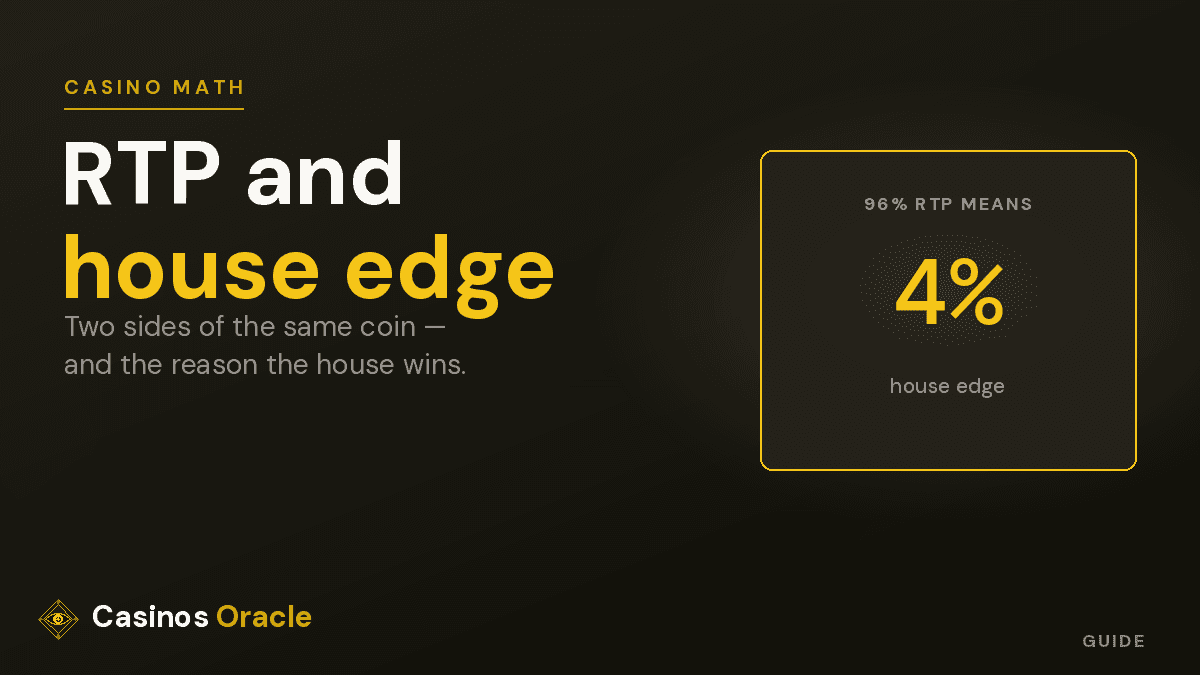
RTP (Return to Player) is just the house edge flipped. A slot with 96% RTP has a 4% house edge. A game with 2.7% house edge has 97.3% RTP. Same math — casinos use RTP for slots because “percentage returned to players” sounds friendlier than “percentage we keep.”
The distinction that trips most players up: RTP is calculated over millions of spins across all players on that game globally. Your individual session can look nothing like that number. A slot with 96% RTP can go 300 spins without a meaningful win, or pay 5,000x on the third spin. The RTP is a long-run statistical average — not a guarantee for your session, your day, or even your month.
Why the Casino Always Wins in the Long Run
Individual players experience variance. The casino experiences the mean. On any given night, some players walk away up, and the casino might run a loss on a particular table. Over a month of operation across thousands of players and millions of bets, the actual results converge tightly on the mathematical expectation.
This is why bankroll size is less important than game choice. A larger bankroll just means more time at the table — and more time means more bets, which gives the house edge more opportunities to work. The math isn’t harsher on big bankrolls; it just has more room to run.
Casino profitability is also diversified across thousands of players simultaneously. Even in a high-variance game, the casino’s exposure is spread over enough bets that the statistical noise mostly cancels out. Your hot streak exists within a framework that has already priced in exactly that kind of variance.
The Edge Varies by Bet, Not Just by Game
This is where many players leave a lot on the table. The house edge isn’t fixed per game — your betting choices within a game determine which edge you’re actually playing against. Craps is the clearest example:
- Pass line bet: 1.41% house edge
- Pass line with 3–4–5x odds behind: combined edge drops to approximately 0.37%
- Any 7 (proposition bet): 16.67% house edge
Three bets at the same table, edges running from 0.37% to 16.67%. The proposition bets in the center of the craps layout — the flashy hardways, any craps, horn bets — are where the house concentrates its biggest edge. Players who stick to the pass/don’t pass and take full odds are playing a structurally different game from players betting the center.
Blackjack has the same dynamic. Basic strategy gets the edge to about 0.5%. Take insurance when you’re not a card counter, and you’ve just accepted a separate side bet with a 5.88% edge, regardless of whether the dealer has blackjack or not. The insurance bet’s math doesn’t change based on what you see on the table — it’s always a bad bet without a genuine count advantage.
What Legitimately Reduces the Edge
Three things actually shift the math:
Optimal strategy. In blackjack, video poker, and craps odds play, documented perfect strategy cuts the house edge significantly. Basic strategy charts reduce blackjack’s edge from 2–4% (what most players run playing by feel) to under 0.5%. That’s not a small difference — it’s a fourfold improvement in expected value per dollar wagered.
Game selection. Choose European roulette over American. Bet banker at baccarat. Avoid the tie bet. Avoid keno. These choices are free, immediate, and have a larger impact on your long-run results than any betting system.
Low-wagering bonuses. A genuine no-wagering-requirement bonus or cashback offer temporarily shifts the math in the player’s direction. The key word is wagering requirement: a bonus with a 50x requirement means wagering 50x the bonus amount before withdrawal, which statistically eliminates any edge the bonus creates. Bonuses with 10x or lower wagering requirements — or no wagering at all — are the ones that genuinely help player EV.
Betting systems don’t work. Martingale, Fibonacci, D’Alembert, Labouchere — these change the distribution of wins and losses within a session but leave the long-run expectation identical. No betting pattern changes the underlying probability of any given game. The house edge is built into each individual bet; stacking bets in a pattern doesn’t remove what’s in each one.
The Practical Takeaway
You can’t eliminate the house edge, but you can minimize it — and that’s worth doing. Stick to games with edges under 2%. Learn basic strategy for blackjack if you play it. Understand the difference between volatility (short-run swings) and house edge (long-run direction) — high variance doesn’t mean better odds.
The casino’s profit comes from the aggregate of all players over time. Your session is one data point in that aggregate. A run of good luck can beat the edge in the short term — that’s variance. Over thousands of sessions, though, the house edge does its arithmetic. Playing the right games and making the right bets is the only lever you actually control.