Pai Gow Poker is the table game with the highest rate of tie hands in any casino — somewhere around 40% of hands result in a push. You won’t go broke quickly. You also won’t win quickly. The game rewards patience and careful hand-splitting over instinct, and the house edge on the main bet is around 2.8% with optimal strategy.
How a Round Works
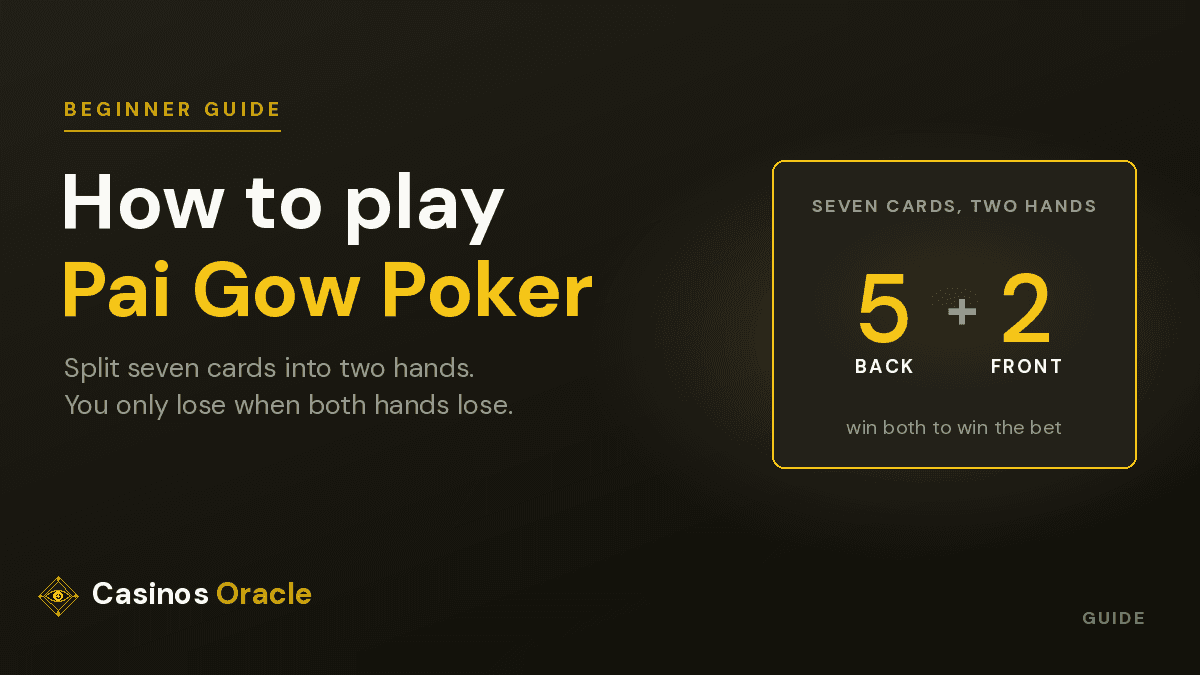
You receive seven cards (six regular cards plus a joker, which is semi-wild — more on that below). You split them into two hands: a five-card hand (“the back”) and a two-card hand (“the front” or “the top”). The five-card hand must be ranked higher than the two-card hand — this rule is enforced by the dealer.
Your five-card hand is compared to the dealer’s five-card hand, and your two-card hand to the dealer’s two-card hand. To win, you need to win both. If you win one and lose one, it’s a push. If you lose both, you lose your bet.
Winning hands pay even money minus a 5% commission. This commission is the source of the house edge — without it, the game would be near-break-even over time. Some casinos collect the commission on all winning bets; others collect it only on net winners per session.
The Joker
Pai Gow Poker uses a 53-card deck with one joker. The joker is semi-wild:
- It can complete a straight, flush, or straight flush
- Otherwise, it counts as an Ace
The joker is most powerful in the back (five-card) hand where it can complete strong combinations. In the front (two-card) hand, it almost always counts as an Ace.
Hand Rankings
The five-card hand uses standard poker rankings (Royal Flush down to High Card). The two-card hand can only be a pair or high card — no straights or flushes possible with two cards. The highest two-card hand is a pair of Aces.
One quirk: in most Pai Gow Poker games, A-2-3-4-5 (the “wheel”) is the second-highest straight, ranking just below A-K-Q-J-10. This is house-specific — check the rules at your table.
How to Split Your Seven Cards
The goal is to make both hands as strong as possible, while keeping the back hand ranked higher than the front. Common guidelines:
- No pair: put the highest card in the back, second and third highest in the front
- One pair: keep the pair in the back, put your two highest remaining cards in the front
- Two pair: if both pairs are low (2s through 6s), keep both in the back; if one is high, split them — higher pair in back, lower pair in front
- Three pair: put the highest pair in the front
- Full house: split it — three of a kind stays in the back, the pair goes in the front (unless the three of a kind is very low, in which case keeping the full house in the back may be better)
- Four of a kind: split them into two pairs if the rank is 8 or above
Most casinos allow you to ask the dealer to show you the “house way” — how they would set the same seven cards. The house way is always a valid setting and is a reasonable default for new players. Playing the house way yourself removes most of the strategic element but keeps you from making obvious mistakes.
Why Pai Gow Is Forgiving
The push rate is genuinely high — roughly 41% of hands. Combined with a relatively slow pace (hands take longer to set than in blackjack or baccarat), your hourly loss rate is among the lowest at any casino table. It’s a game where $100 can last several hours, making it a reasonable choice for players who want extended playing time without heavy exposure.