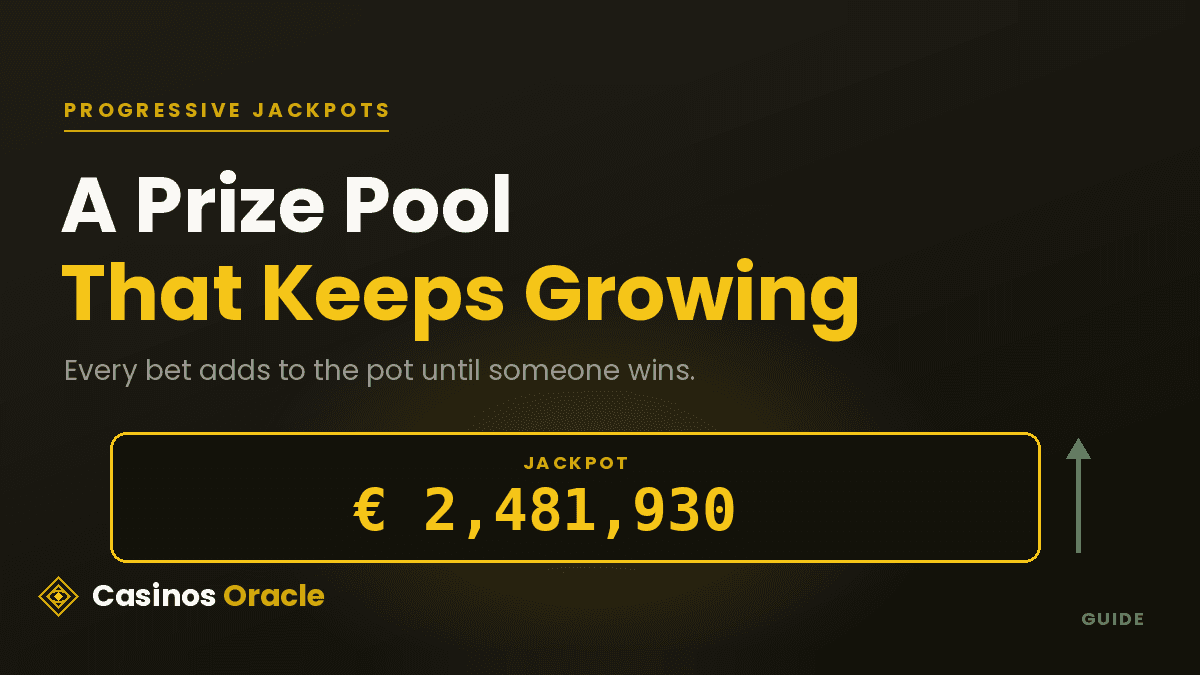
Every bet you place on a progressive jackpot slot contributes a small fraction, typically 1–3%, to a shared prize pool. Across thousands of players spinning simultaneously at dozens of casinos, that pool grows fast. When one player hits the jackpot combination, they win the entire accumulated total. Then the jackpot resets to its seed value and starts building again.
How the Funding Mechanism Works
Game providers (Microgaming, NetEnt, Playtech, IGT) set a contribution rate that’s taken from every wager before the base game RTP applies. On Mega Moolah, for example, roughly 3% of every bet goes to the jackpot pool rather than into the regular game’s pay table. This is why progressive jackpot slots often have lower base-game RTPs than comparable non-progressive slots, the premium is funding the jackpot.
The “seed” value is the minimum the jackpot resets to after a win. Mega Moolah seeds at $1 million. Mega Fortune seeds at €1 million. The operator or provider funds this seed, guaranteeing the jackpot is never zero.
Network Jackpots vs Local Jackpots
The scale of a progressive depends on how many players feed into it:
Network (Wide-Area) Jackpots
These pool bets from every player across every casino that runs the game, potentially hundreds of casinos simultaneously. The result is the massive eight-figure jackpots associated with Mega Moolah (record winner: €23.6 million in 2021), Mega Fortune, and Jackpot Giant. The tradeoff: the odds of winning are correspondingly astronomical. We’re talking 1-in-50-million or worse for the top tier.
Local Jackpots
Pool bets only from players at a single casino. The prize grows more slowly and reaches more modest amounts, typically thousands or tens of thousands rather than millions. But the odds are better by several orders of magnitude. Some local jackpots are won multiple times per day.
In-Game (Standalone) Jackpots
A progressive that feeds only from that specific game at that specific casino’s instance of it. Smallest prize, most frequent winner.
Must-Drop Jackpots: A Different Structure
Must-drop (or “must-win-by”) jackpots guarantee the prize drops before a certain threshold, either a time limit (daily or hourly), a prize amount ceiling, or a combination. Examples: Lightning Box’s Daily Jackpot games, or Pragmatic Play’s Drops & Wins prize pool.
The mechanic changes the probability curve. As the jackpot approaches its must-drop threshold, the trigger probability effectively increases, the game is programmed to award the jackpot before crossing the line. Players who understand this sometimes time their sessions to capture this increased-probability window. It doesn’t make the jackpot likely, but it shifts the odds compared to a standard progressive.
Must-drop jackpots are typically smaller (hundreds to thousands of dollars) but hit far more frequently than network progressives. For players who want jackpot variance without the near-impossible odds of Mega Moolah, they’re a reasonable middle ground.
Jackpot Tiers: Most Games Have Several
Many progressive jackpot games run multiple prize tiers simultaneously. Mega Moolah has four: Mini, Minor, Major, and Mega. The Mini jackpot hits frequently and pays a few hundred dollars. The Mini and Minor jackpots keep players engaged while the Mega jackpot builds. All four are funded from the same contribution percentage, the game’s internal probability tables determine what fraction triggers which tier.
Age of the Gods (Playtech) runs a similar four-tier structure. This design keeps session entertainment value up even when the top prize hasn’t hit in months.
The Jackpot Trigger: RNG or Bonus Wheel?
Different games use different trigger mechanisms:
- Random RNG trigger: any spin can trigger the jackpot game regardless of what’s showing on the reels. This is Mega Moolah’s method, a random number determines whether the jackpot wheel activates, independent of the base spin result. It means any bet size can theoretically trigger it (though larger bets increase the probability).
- Reel combination trigger: a specific symbol combination on the reels activates the jackpot bonus. Hallmark: you see the jackpot symbols appear on screen, then enter a bonus round. More visible, more dramatic, players know exactly when they’re in jackpot contention.
- Bonus-within-bonus trigger: reach a bonus game, then within that bonus pick items or spin a wheel to reveal jackpot prizes. Common in older Playtech jackpot titles.
What Bet Size Actually Affects
For games where the jackpot trigger probability scales with bet size, betting maximum increases your odds relative to minimum bet, but the absolute odds remain extremely low. On Mega Moolah, the jackpot wheel trigger probability at max bet is still roughly 1-in-50,000 spins before accounting for the wheel’s Mega Jackpot sector.
Some games require maximum bet to be jackpot-eligible at all. If you’re playing a progressive at less than max bet, check whether you’re actually contributing to, and eligible for, the top prize.
The RTP Reality on Progressive Slots
Published RTPs for progressive jackpot slots include the jackpot contribution. Mega Moolah’s base game RTP is approximately 88.12%, the remaining ~3% is in the jackpot pool. That “full” RTP is only realized if you happen to win the jackpot. The base game alone, without jackpot wins, returns around 85–88%.
This is a meaningful distinction. If you never win the jackpot (which is the statistically likely outcome for any given player), you’re playing a game with a below-average RTP. Progressive jackpot slots trade base-game RTP for jackpot potential. That’s the explicit deal, know it going in.
Jackpots at higher seed values (Mega Moolah at $5M vs $1M) technically offer better player EV because more total money is in the pool, but the practical difference for any individual player is essentially zero given the odds.