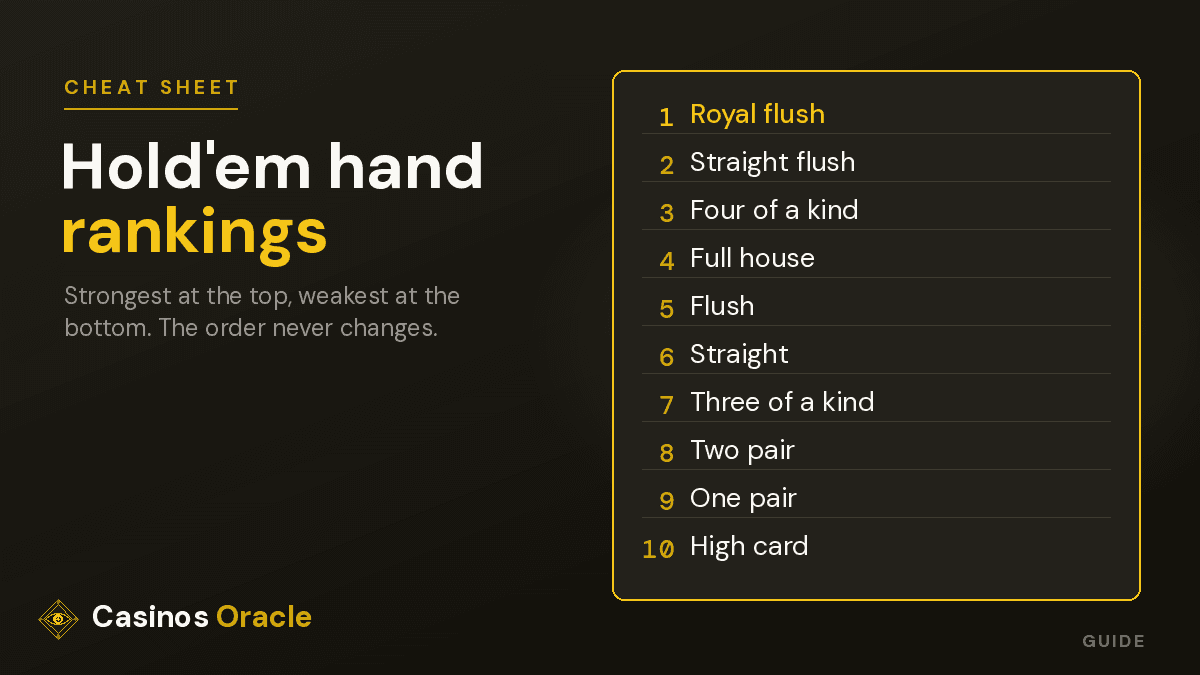
Standard poker hand rankings apply to Texas Hold’em, Omaha, Seven-Card Stud, and most other poker variants. There are 10 categories, ranked from strongest to weakest. In a showdown, the player with the highest-ranking hand wins. Ties are broken by comparing individual card ranks within the same category.
The 10 Hand Rankings
1. Royal Flush
A, K, Q, J, 10 — all the same suit. The best possible hand in standard poker. Cannot be beaten by any other hand. Example: A♠ K♠ Q♠ J♠ 10♠
2. Straight Flush
Five consecutive cards, all the same suit. Example: 7♥ 8♥ 9♥ 10♥ J♥. Tiebreaker: the highest card in the straight. A Royal Flush is technically the highest straight flush.
3. Four of a Kind (Quads)
Four cards of the same rank. Example: K♠ K♥ K♦ K♣ 7♠. Tiebreaker: higher quad rank wins. If quads are equal (possible in community card games), the kicker (fifth card) decides.
4. Full House
Three cards of one rank and two of another. Example: Q♠ Q♥ Q♦ 9♣ 9♠ (Queens full of Nines). Tiebreaker: higher three-of-a-kind rank wins. If equal, higher pair rank decides.
5. Flush
Five cards of the same suit, not in sequence. Example: A♣ J♣ 8♣ 5♣ 2♣. Tiebreaker: highest card wins. If the highest card ties, compare second-highest, and so on.
6. Straight
Five consecutive cards, mixed suits. Example: 6♠ 7♥ 8♣ 9♦ 10♠. Tiebreaker: highest card wins. Ace can be high (A-K-Q-J-10) or low (A-2-3-4-5, called a “wheel”), but not both (Q-K-A-2-3 is not a straight).
7. Three of a Kind (Trips / Set)
Three cards of the same rank. Example: J♠ J♥ J♦ 8♠ 4♣. Tiebreaker: rank of the three-of-a-kind. Then kickers (highest remaining cards) are compared in order.
8. Two Pair
Two different pairs. Example: A♠ A♣ 7♥ 7♦ K♠. Tiebreaker: higher pair wins. If equal, lower pair. If still equal, kicker.
9. One Pair
Two cards of the same rank. Example: 10♠ 10♣ A♥ 7♦ 3♠. Tiebreaker: higher pair rank. Then kickers in order (first, second, third) if pairs tie.
10. High Card
No pair, no flush, no straight — the best five-card hand that doesn’t qualify for any category above. Example: A♠ K♣ 9♥ 5♦ 2♠ (Ace-high). Tiebreaker: highest card, then second-highest, and so on.
Summary Table
| Rank | Hand | Example |
|---|---|---|
| 1 (Best) | Royal Flush | A♠ K♠ Q♠ J♠ 10♠ |
| 2 | Straight Flush | 9♥ 8♥ 7♥ 6♥ 5♥ |
| 3 | Four of a Kind | K♠ K♥ K♦ K♣ 7♠ |
| 4 | Full House | Q♠ Q♥ Q♦ 9♣ 9♠ |
| 5 | Flush | A♣ J♣ 8♣ 5♣ 2♣ |
| 6 | Straight | 6♠ 7♥ 8♣ 9♦ 10♠ |
| 7 | Three of a Kind | J♠ J♥ J♦ 8♠ 4♣ |
| 8 | Two Pair | A♠ A♣ 7♥ 7♦ K♠ |
| 9 | One Pair | 10♠ 10♣ A♥ 7♦ 3♠ |
| 10 (Worst) | High Card | A♠ K♣ 9♥ 5♦ 2♠ |
Common Tiebreaker Mistakes
Suits are never used to break ties in standard poker — there’s no hierarchy of clubs, diamonds, hearts, spades. A flush in spades doesn’t beat a flush in hearts of the same rank.
In Texas Hold’em, the “best five cards from seven” rule means players must identify the optimal combination from their two hole cards and five community cards. A player holding 2♠ 3♠ on a board of A♠ K♠ Q♠ J♠ 10♠ has a Royal Flush — their hole cards don’t help, but the five community cards already form the best possible hand. Both players in this situation “play the board” and split the pot.