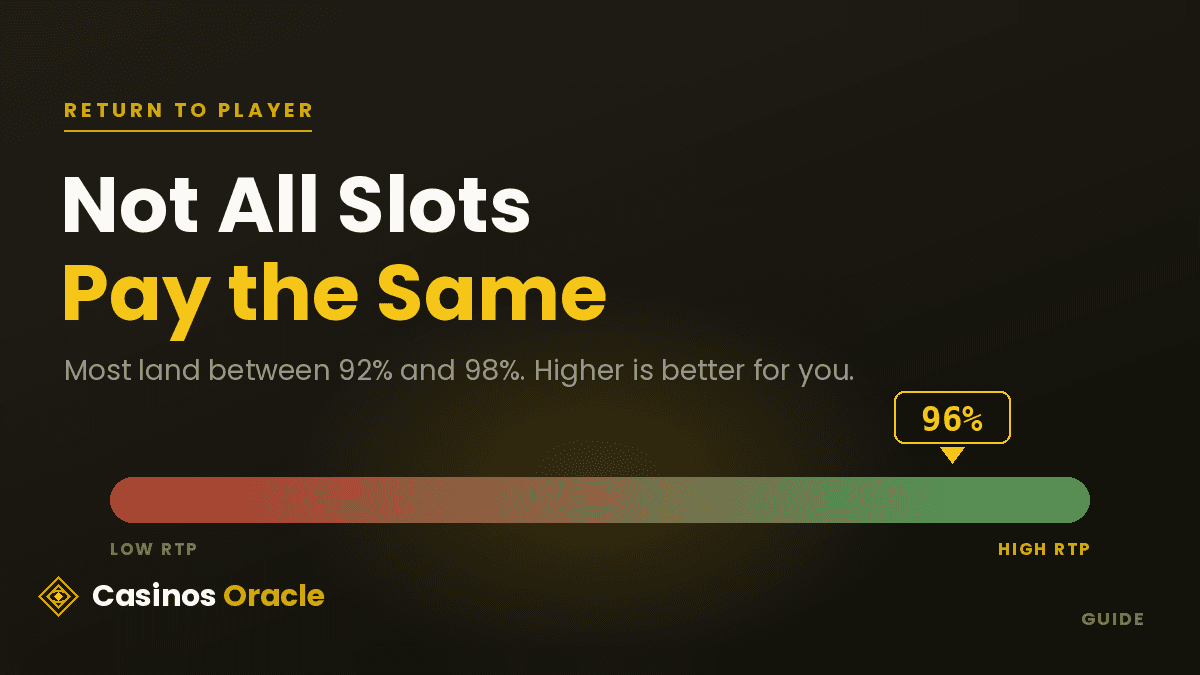
RTP stands for Return to Player. It’s the percentage of all money wagered on a game that gets paid back to players in winnings — calculated over millions of rounds, across all players, over the entire lifetime of the game. A slot with 96% RTP returns $96 for every $100 wagered. The casino keeps the other $4. That 4% gap is the house edge.
How RTP Is Calculated
Game developers calculate RTP through mathematical modeling of the game’s probability distribution. Every symbol, every payline, every bonus trigger has a defined probability. The developer maps out every possible outcome, multiplies each by its probability, and sums the expected return. The result — expressed as a percentage — is the theoretical RTP.
Before a game launches, independent testing labs (eCOGRA, iTech Labs, GLI) run millions of simulated spins to verify that the game’s actual output matches its theoretical RTP within an acceptable margin. Certified RTPs are the ones you can trust. If a game claims 96% RTP without certification behind it, that number is self-reported and unverifiable.
Theoretical vs Actual RTP — Why They Differ
The published RTP is theoretical — it describes what happens across an infinite number of spins. Over any finite period, actual results will deviate from that figure. The shorter the period, the larger the potential deviation.
Imagine flipping a coin. Over 10 flips you might get 7 heads and 3 tails — that’s 70% heads, well above the 50% theoretical probability. Over 10,000 flips the result converges toward 50% almost certainly. Slot RTPs work the same way, just with far more complexity and much longer timescales.
In practice: a typical hour-long slot session involves maybe 400–600 spins. That’s a vanishingly small sample. Your session RTP might be 120% (you won more than you bet) or 30% (you lost most of your buy-in) — both are entirely consistent with a game that has 96% theoretical RTP. Neither proves the game is generous or rigged.
RTP vs Hit Rate: Not the Same Thing
RTP and hit rate (or hit frequency) measure different things. RTP tells you what fraction of wagered money comes back as winnings over time. Hit rate tells you how often the game produces any winning combination per spin — regardless of size.
A game can have a high hit rate and a poor RTP — if most of its frequent wins are tiny (0.5x your bet or less), they’re just slowing your bankroll drain without adding real value. Conversely, a low-hit-rate game can have excellent RTP if its infrequent wins are large. Pay attention to both metrics together, not just one.
RTP Across Different Game Types
RTP isn’t just a slot concept — every casino game has one, though table games are usually described by house edge instead. Here’s how they compare:
| Game Type | Typical RTP Range | Conditions |
|---|---|---|
| Online slots | 92–98% | Varies heavily by provider and title |
| Land-based slots | 85–92% | Lower due to higher operating costs |
| Blackjack (basic strategy) | 99.40–99.60% | Drops to ~96% without optimal play |
| European Roulette | 97.30% | Single zero wheel |
| American Roulette | 94.74% | Double zero wheel |
| Baccarat (Banker) | 98.94% | After 5% commission |
| Video Poker (full-pay JoB) | 99.54% | Perfect strategy required |
| Live dealer slots/games | 94–97% | Depends on the specific game |
Multi-RTP Games: Same Game, Different Payouts
Some game providers offer the same slot in multiple RTP versions. Pragmatic Play’s Sweet Bonanza, for instance, is available in 96.48% and 94.08% variants. Casinos choose which version to license and run. The game looks identical but pays out differently over time.
The RTP in the game’s info screen (the “i” button) shows you the version that’s actually running at that specific casino. Provider websites typically list the maximum RTP — the in-game paytable is the source of truth for what you’re actually playing.
How to Find the RTP of Any Game
- In-game info button: almost every online slot has an “i” or “?” button that opens the paytable. The RTP is usually listed at the bottom of the rules section.
- Game provider’s website: NetEnt, Pragmatic Play, Play’n GO, Microgaming, and most major studios publish RTPs for their entire catalog.
- Regulatory databases: the MGA and UKGC publish verified RTPs for licensed games. If a game’s RTP in these databases differs from what’s in-game, that’s a concern worth escalating.
- Casino help sections: regulated casinos in some jurisdictions are required to publish game RTPs. UK-licensed sites are particularly thorough about this.
What RTP to Look For
For online slots, 96% is a reasonable benchmark. Games at 97%+ are genuinely good value. Below 94% starts to become notably disadvantageous — you’re paying a steeper house edge per dollar wagered.
That said, RTP is one of several factors. A 96% high-volatility slot can be more punishing to a small bankroll than a 94% low-volatility slot, because the variance eats your funds before you see any significant wins. Consider RTP alongside volatility and your session budget together.